Feeds:
Posts
Comments

I got to do a bit of policy evaluation and writing at work recently and one of the articles I co-authored with a colleague was published in NACCHO’s “Preparedness Brief” E-newsletter. The article summarizes the recently-published National Health Security Strategy (NHSS) and its potential implications for public health preparedness planning at the local level. The article focuses on a town hall session held at the Public Health Preparedness Summit in February, during which key stakeholders had an opportunity to provide feedback on the document.

If such topics interest you, check out the article, National Health Security Strategy Town Hall.

If this work excites you, consider taking a look at the position openings on the preparedness team at NACCHO.

First, check out Dan’s new personal blog — it should keep you updated on his (and our) activities: http://wastedbrains.com.

Second, my former colleague, Kate, is on a venture round-the-world. Check out her blog, The Kate Escape. But fair warning, it might make you so jealous that you spit: http://thekateescape.tumblr.com.

In honor of Mother’s Day, this post was a joint writing project with my mother, Dr. Wanda Venters. To be fair, most of the content was hers. Dr. Venters has practiced pediatrics at Parker Pediatrics and Adolescents for 18 years and before that practiced in the army for 10 years. Having been in private practice and government-run medicine, she has a unique and learned viewpoint of the current debate on health care regulation.

Electronic medical records (EMRs) have tremendous potential to transform our medical system. However, healthcare consumers and pundits hold some misconceptions about the status of EMRs in the United States. EMR systems have two immense challenges, one involving patient privacy and another related to system coordination. These challenges can only be overcome through leadership and innovation by private companies and regulation by the federal government.


There are many advantages to EMRs–legibility of records, coordination with pharmacies, improved data collection. EMRs will eventually improve record keeping and coordination of medical care. They will make outcome studies—the best way to control medical costs–much easier and more reliable. However, it is important to realize the limitations of EMRs. Decreased malpractice is not a prominent feature of the use of EMRs. The care provider is the single most important predictor of malpractice whether an office uses paper or electronic medical records. Further, EMRs do not always save providers time, which would allow them to either spend more time with each patient or see more patients. A recent visit to a friend who is still working in the army hospital were I did my internship 30 years ago revealed this phenomenon. Whereas we often saw 20 patients a day, the current residents in the general pediatric clinic can barely see eight. The electronic documentation of the encounters accounts for the remainder of their time. 


EMRs are also limited by security and privacy concerns, but perhaps even more dauntingly, they are encumbered by a lack of coordination. The technology for EMRs has not kept up with that of banking and other Internet services. Whereas I have been doing online banking, which requires a high level of security, for over 10 years, I still struggle with the multiple systems of EMRs in hospitals and other physician offices. Contrary to popular conceptions, different EMR systems do not “talk” to each other. Each hospital has a unique portal of entry into its database and very different ways of navigation. A physician who works in a single hospital will get proficient with its system. A physician who works at multiple hospitals will carry a small briefcase of passwords and navigation clues. Even EMR systems within the same hospital do not always talk to each other. After reviewing an X-ray report, I sent a patient to the emergency room of the same hospital where she had received the X-ray. However, the main hospital used a different EMR system than that used in the emergency room and thus the patient had to get a hard copy of the X-ray and carry it to the ER. Even within the government, there are different systems of electronic medical records. The army hospital where I did my residency does not have the same EMR as the VA system that is reportedly easy and fast to navigate. Therefore, even the Army and VA EMR systems do not “talk” to each other.


In the short term, EMRs will not decrease costs and will not streamline medical care delivery. Many medical offices have gone to EMRs. Those that did so early are now on their 3rd or 4th system. As an investment of one quarter to a million dollars each time, it is hard to argue this technology is a cost saving for a small business. As my practice prepares to get EMR, we have been warned of many pitfalls. The biggest pitfall is that we would choose a vendor that suddenly stops supporting EMR, leaving us with records that we can no longer access. This is not just a theoretical problem-it has happened. Transferring our records to a system that becomes obsolete is a tremendous risk for a small business. These challenges can only be overcome through leadership. Private companies must do what they do best; they must innovate quickly, competing to create the most intuitive, secure system that can easily coordinate with other systems. The federal government must also do what it does best, it must standardize a baseline language for EMRs, guaranteeing that data transferred to EMR systems will remain accessible and providing small businesses with a sense of security that they can safely transfer their records.

***UPDATE: Denverpost.com picked up this article, see the online published version of “The benefits and limitations of electronic medical records.”


Spring

I have been pretty excited about this spring — and it’s not just that springtime on the east coast is beautiful (though it is) and that the days are getting longer (though I love that too), this is the first spring since I finished undergrad three years ago that I will remain in the same physical location throughout the season. I am eager to experience this season of change from a stable place. The year after I finished undergrad, I moved to Honduras in February, arriving right at the beginning of what they call their summer, which is in fact their dry season. The following year, after finishing my first year of grad school, I moved to Seattle for the summer to intern on the health care team at GAO. Last year, I moved to Colorado after finishing grad school, and then over the summer, I moved again to DC to begin working at NACCHO. While the spring air in DC is filled with the scent of cherry blossoms and change, I am looking forward to experiencing the changes from the same one-bedroom apartment on Capitol hill.

surprise!

Last weekend, my litter sister, Kelly, flew to DC and completely surprised me for my birthday. She and Dan had been in cahoots. I am amazed by how many people were able to keep it a surprise. I came out of my building after work on Friday expecting to see Dan and was shocked by the gorgeous tall woman standing next to him, who I soon realized was my little sis. Friday night we grabbed appetizers in Dupont and then Kelly went off to surprise another one of her friends at Georgetown University.

Saturday, we walked through Eastern Market and joined my friends for dinner in Georgetown followed by a piano bar in Barracks Row. Sunday we walked the Mall a bit, saw the Capitol and the Washington Monument and went to the Holocaust Memorial Museum — allowing Dan and I to check yet another place off our DC tourist map. I found the museum to be more of a memorial than a museum, and it didn’t teach me much I didn’t already know — though as Dan pointed out, I was a history major, so maybe most people don’t have the same knowledge of the time period. I was searching for a greater understanding of “how” — how an entire population, an entire world, could know what was happening and do very little to stop it, how a people can allow themselves to be interned. I know about the horrors, but I understand less about how. Maybe Rwanada and Darfur help explain how. The museum is powerful as a memorial, and an important one. One of my friends commented on the shoes — an exhibit showing rows and rows of shoes piled on top of one another — shoes that were abandoned outside a gas chamber. And though I am aware of differences, my mind flashed back to what another friend, who was living in NYC at the time, had said about 9/11 — “it was the shoes, the shoes outside the buildings.”

Kelly and I finished our weekend with a movie at home on Sunday night. It was wonderful to get to see her and catch up on some of that sister stuff that is sometimes tough to share over 2,000 miles.

In somewhat related news, Dan, who has a genuine gift for such writing, has updated his Yelp profile to include reviews of some of the restaurants we have visited in DC, funny and insightful. If you are looking for a place to eat in DC, or just want to know more about what we have been eating since we got here, check out the reviews.

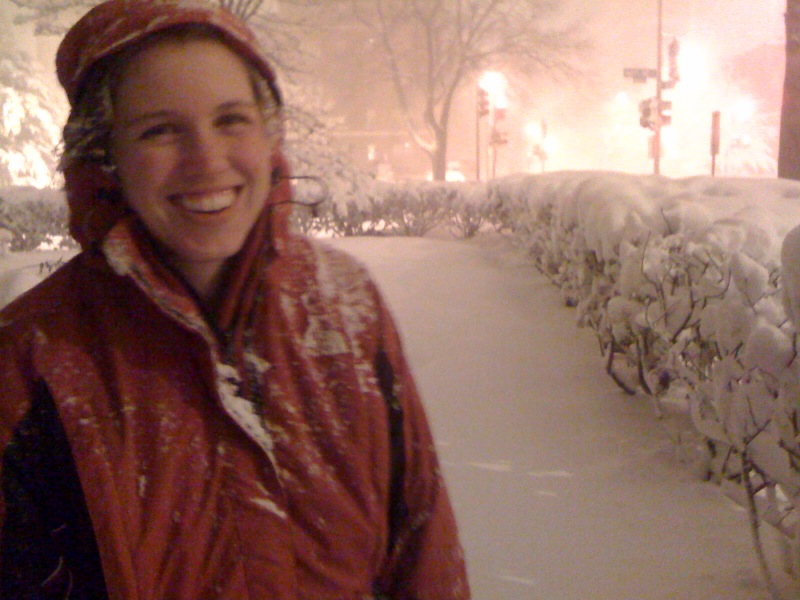
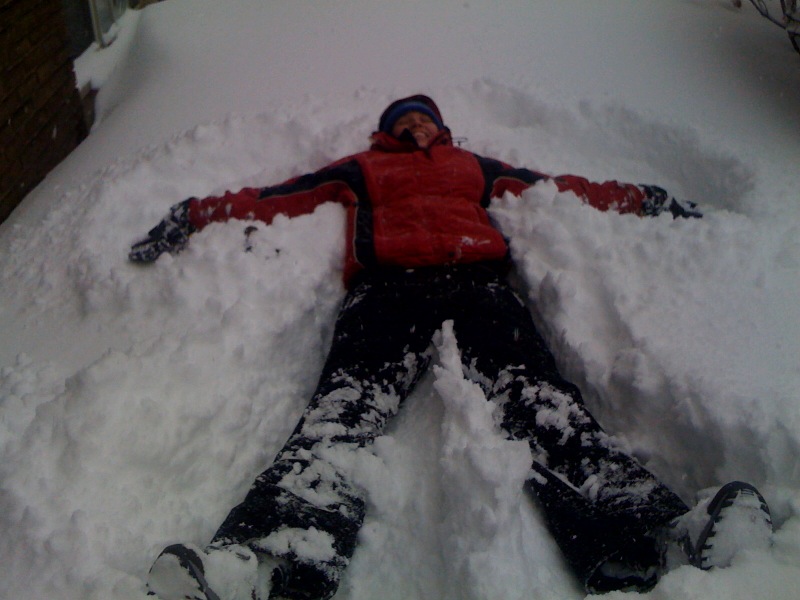
We are emerging from our second once-in-a-lifetime blizzard in DC this year. Obama dubbed the storm snowmageddon, though snowpocalypse2, after the snowpocalypse1 storm on December 19, and snowtorious B.I.G. remain popular. Officially 17.8″ fell at National Airport, the fourth largest snowfall since the National Weather Service began keeping records, but 26″ fell in the district. It stopped snowing in the early evening yesterday and the sun is out today. People are approaching their cars on the side of the roads, shovels in hand, but usually start laughing out loud at the enormity of the task before they even get their first scoop of snow into their shovel. Once they have the snow in the shovel, they look around and laugh again, because there is absolutely no where to put it.

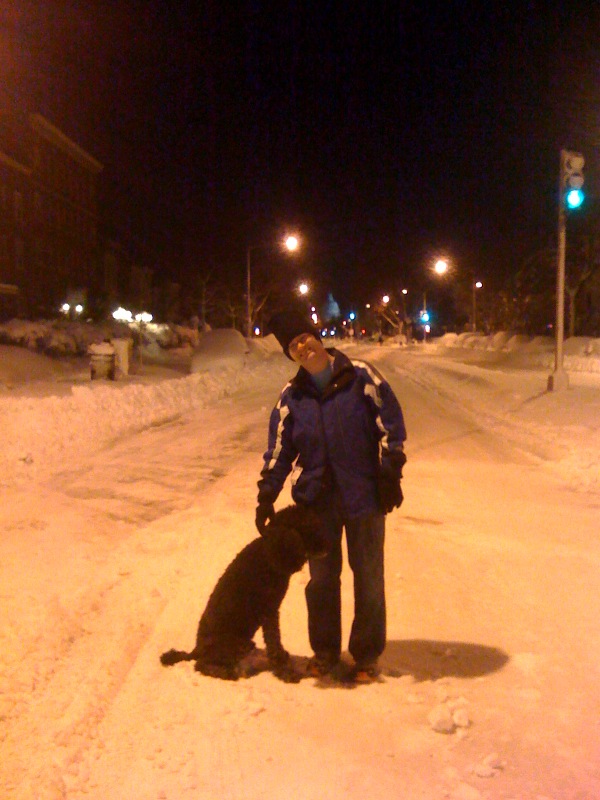
Other than being completely snowed in, life in the district has continued fairly normally. We never lost power (though more than 100,000 people in the area have) and the metro continued serving the underground stations (which includes ours), though trains were only running every 30 minutes and they stopped service early last night. Despite its unofficial motto, (“Neither snow nor rain nor heat nor gloom of night stays these couriers from the swift completion of their appointed rounds,”) the Postal Service was not able to make its rounds Saturday, for the first time in 30 years. Streets were practically devoid of cars for more than 24 hours and there was something surreal about being able to frolic down the middle of the streets, Spot running free. Spot is in her dog bed snoring after spending so much time playing in the snow yesterday. The Mayor says that he is trying to have the city ready for business by Monday morning, but where the snow is cleared from the sidewalks, it comes up past my knees and past Spot’s head, so we’ll see.